Description
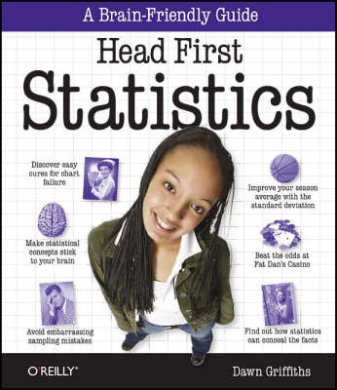
; Advance Praise for Head First Statistics; Praise for other Head First books; Author of Head First Statistics; How to use this Book: Intro; Who is this book for?; We know what you’re thinking; We know what your brain is thinking; Metacognition: thinking about thinking; Here’s what WE did; Read Me; The technical review team; Acknowledgments; Safari Books Online; Chapter 1: Visualizing Information: First Impressions; 1.1 Statistics are everywhere; 1.2 But why learn statistics?; 1.3 A tale of two charts; 1.4 Manic Mango needs some charts; 1.5 The humble pie chart; 1.6 Chart failure; 1.7 Bar charts can allow for more accuracy; 1.8 Vertical bar charts; 1.9 Horizontal bar charts; 1.10 It’s a matter of scale; 1.11 Using frequency scales; 1.12 Dealing with multiple sets of data; 1.13 Your bar charts rock; 1.14 Categories vs. numbers; 1.15 Dealing with grouped data; 1.16 To make a histogram, start by finding bar widths; 1.17 Manic Mango needs another chart; 1.18 Make the area of histogram bars proportional to frequency; 1.19 Step 1: Find the bar widths; 1.20 Step 2: Find the bar heights; 1.21 Step 3: Draw your chart-a histogram; 1.22 Histograms can’t do everything; 1.23 Introducing cumulative frequency; 1.24 Drawing the cumulative frequency graph; 1.25 Choosing the right chart; 1.26 Manic Mango conquered the games market!; Chapter 2: Measuring Central Tendency: The Middle Way; 2.1 Welcome to the Health Club; 2.2 A common measure of average is the mean; 2.3 Mean math; 2.4 Dealing with unknowns; 2.5 Back to the mean; 2.6 Handling frequencies; 2.7 Back to the Health Club; 2.8 Everybody was Kung Fu fighting; 2.9 Our data has outliers; 2.10 The butler outliers did it; 2.11 Watercooler conversation; 2.12 Finding the median; 2.13 Business is booming; 2.14 The Little Ducklings swimming class; 2.15 Frequency Magnets; 2.16 Frequency Magnets; 2.17 What went wrong with the mean and median?; 2.18 Introducing the mode; 2.19 Congratulations!; Chapter 3: Measuring Variability and Spread: Power Ranges; 3.1 Wanted: one player; 3.2 We need to compare player scores; 3.3 Use the range to differentiate between data sets; 3.4 The problem with outliers; 3.5 We need to get away from outliers; 3.6 Quartiles come to the rescue; 3.7 The interquartile range excludes outliers; 3.8 Quartile anatomy; 3.9 We’re not just limited to quartiles; 3.10 So what are percentiles?; 3.11 Box and whisker plots let you visualize ranges; 3.12 Variability is more than just spread; 3.13 Calculating average distances; 3.14 We can calculate variation with the variance…; 3.15 …but standard deviation is a more intuitive measure; 3.16 A quicker calculation for variance; 3.17 What if we need a baseline for comparison?; 3.18 Use standard scores to compare values across data sets; 3.19 Interpreting standard scores; 3.20 Statsville All Stars win the league!; Chapter 4: Calculating Probabilities: Taking Chances; 4.1 Fat Dan’s Grand Slam; 4.2 Roll up for roulette!; 4.3 Your very own roulette board; 4.4 Place your bets now!; 4.5 What are the chances?; 4.6 Find roulette probabilities; 4.7 You can visualize probabilities with a Venn diagram; 4.8 It’s time to play!; 4.9 And the winning number is…; 4.10 Let’s bet on an even more likely event; 4.11 You can also add probabilities; 4.12 You win!; 4.13 Time for another bet; 4.14 Exclusive events and intersecting events; 4.15 Problems at the intersection; 4.16 Some more notation; 4.17 Another unlucky spin…; 4.18 …but it’s time for another bet; 4.19 Conditions apply; 4.20 Find conditional probabilities; 4.21 You can visualize conditional probabilities with a probability tree; 4.22 Trees also help you calculate conditional probabilities; 4.23 Bad luck!; 4.24 We can find P(Black l Even) using the probabilities we already have; 4.25 Step 1: Finding P(Black n Even); 4.26 So where does this get us?; 4.27 Step 2: Finding P(Even); 4.28 Step 3: Finding P(Black l Even); 4.29 These results can be generalized to other problems; 4.30 Use the Law of Total Probability to find P(B); 4.31 Introducing Bayes’ Theorem; 4.32 We have a winner!; 4.33 It’s time for one last bet; 4.34 If events affect each other, they are dependent; 4.35 If events do not affect each other, they are independent; 4.36 More on calculating probability for independent events; 4.37 Winner! Winner!; Chapter 5: Using Discrete Probability Distributions: Manage Your Expectations; 5.1 Back at Fat Dan’s Casino; 5.2 We can compose a probability distribution for the slot machine; 5.3 Expectation gives you a prediction of the results…; 5.4 … and variance tells you about the spread of the results; 5.5 Variances and probability distributions; 5.6 Let’s calculate the slot machine’s variance; 5.7 Fat Dan changed his prices; 5.8 There’s a linear relationship between E(X) and E(Y); 5.9 Slot machine transformations; 5.10 General formulas for linear transforms; 5.11 Every pull of the lever is an independent observation; 5.12 Observation shortcuts; 5.13 New slot machine on the block; 5.14 Add E(X) and E(Y) to get E(X + Y)…; 5.15 … and subtract E(X) and E(Y) to get E(X – Y); 5.16 You can also add and subtract linear transformations; 5.17 Jackpot!; Chapter 6: Permutations and Combinations: Making Arrangements; 6.1 The Statsville Derby; 6.2 It’s a three-horse race; 6.3 How many ways can they cross the finish line?; 6.4 Calculate the number of arrangements; 6.5 Going round in circles; 6.6 It’s time for the novelty race; 6.7 Arranging by individuals is different than arranging by type; 6.8 We need to arrange animals by type; 6.9 Generalize a formula for arranging duplicates; 6.10 It’s time for the twenty-horse race; 6.11 How many ways can we fill the top three positions?; 6.12 Examining permutations; 6.13 What if horse order doesn’t matter; 6.14 Examining combinations; 6.15 It’s the end of the race; Chapter 7: Geometric, Binomial, and Poisson Distributions: Keeping Things Discrete; 7.1 Meet Chad, the hapless snowboarder; 7.2 We need to find Chad’s probability distribution; 7.3 There’s a pattern to this probability distribution; 7.4 The probability distribution can be represented algebraically; 7.5 The pattern of expectations for the geometric distribution; 7.6 Expectation is 1/p; 7.7 Finding the variance for our distribution; 7.8 You’ve mastered the geometric distribution; 7.9 Should you play, or walk away?; 7.10 Generalizing the probability for three questions; 7.11 Let’s generalize the probability further; 7.12 What’s the expectation and variance?; 7.13 Binomial expectation and variance; 7.14 The Statsville Cinema has a problem; 7.15 Expectation and variance for the Poisson distribution; 7.16 So what’s the probability distribution?; 7.17 Combine Poisson variables; 7.18 The Poisson in disguise; 7.19 Anyone for popcorn?; Chapter 8: Using the Normal Distribution: Being Normal; 8.1 Discrete data takes exact values…; 8.2 … but not all numeric data is discrete; 8.3 What’s the delay?; 8.4 We need a probability distribution for continuous data; 8.5 Probability density functions can be used for continuous data; 8.6 Probability = area; 8.7 To calculate probability, start by finding f(x)…; 8.8 … then find probability by finding the area; 8.9 We’ve found the probability; 8.10 Searching for a soul sole mate; 8.11 Male modelling; 8.12 The normal distribution is an “ideal” model for continuous data; 8.13 So how do we find normal probabilities?; 8.14 Three steps to calculating normal probabilities; 8.15 Step 1: Determine your distribution; 8.16 Step 2: Standardize to N(0, 1); 8.17 To standardize, first move the mean…; 8.18 … then squash the width; 8.19 Now find Z for the specific value you want to find probability for; 8.20 Step 3: Look up the probability in your handy table; 8.21 Julie’s probability is in the table; 8.22 And they all lived happily ever after; Chapter 9: Using the Normal Distribution ii: Beyond Normal; 9.1 Love is a roller coaster; 9.2 All aboard the Love Train; 9.3 Normal bride + normal groom; 9.4 It’s still just weight; 9.5 How’s the combined weight distributed?; 9.6 Finding probabilities; 9.7 More people want the Love Train; 9.8 Linear transforms describe underlying changes in values…; 9.9 …and independent observations describe how many values you have; 9.10 Expectation and variance for independent observations; 9.11 Should we play, or walk away?; 9.12 Normal distribution to the rescue; 9.13 When to approximate the binomial distribution with the normal; 9.14 Revisiting the normal approximation; 9.15 The binomial is discrete, but the normal is continuous; 9.16 Apply a continuity correction before calculating the approximation; 9.17 All aboard the Love Train; 9.18 When to approximate the binomial distribution with the normal; 9.19 A runaway success!; Chapter 10: Using Statistical Sampling: Taking Samples; 10.1 The Mighty Gumball taste test; 10.2 They’re running out of gumballs; 10.3 Test a gumball sample, not the whole gumball population; 10.4 How sampling works; 10.5 When sampling goes wrong; 10.6 How to design a sample; 10.7 Define your sampling frame; 10.8 Sometimes samples can be biased; 10.9 Sources of bias; 10.10 How to choose your sample; 10.11 Simple random sampling; 10.12 How to choose a simple random sample; 10.13 There are other types of sampling; 10.14 We can use stratified sampling…; 10.15 …or we can use cluster sampling…; 10.16 …or even systematic sampling; 10.17 Mighty Gumball has a sample; Chapter 11: Estimating Populations and Samples: Making Predictions; 11.1 So how long does flavor really last for?; 11.2 Let’s start by estimating the population mean; 11.3 Point estimators can approximate population parameters; 11.4 Let’s estimate the population variance; 11.5 We need a different point estimator than sample variance; 11.6 Which formula’s which?; 11.7 Mighty Gumball has done more sampling; 11.8 It’s a question of proportion; 11.9 Buy your gumballs here!; 11.10 So how does this relate to sampling?; 11.11 The sampling distribution of proportions; 11.12 So what’s the expectation of Ps?; 11.13 And what’s the variance of Ps?; 11.14 Find the distribution of Ps; 11.15 Ps follows a normal distribution; 11.16 How many gumballs?; 11.17 We need probabilities for the sample mean; 11.18 The sampling distribution of the mean; 11.19 Find the expectation for X; 11.20 What about the the variance of X?; 11.21 So how is X distributed?; 11.22 If n is large, X can still be approximated by the normal distribution; 11.23 Using the central limit theorem; 11.24 Sampling saves the day!; Chapter 12: Constructing Confidence Intervals: Guessing with Confidence; 12.1 Mighty Gumball is in trouble; 12.2 The problem with precision; 12.3 Introducing confidence intervals; 12.4 Four steps for finding confidence intervals; 12.5 Step 1: Choose your population statistic; 12.6 Step 2: Find its sampling distribution; 12.7 Point estimators to the rescue; 12.8 We’ve found the distribution for X; 12.9 Step 3: Decide on the level of confidence; 12.10 How to select an appropriate confidence level; 12.11 Step 4: Find the confidence limits; 12.12 Start by finding Z; 12.13 Rewrite the inequality in terms of ; 12.14 Finally, find the value of X; 12.15 You’ve found the confidence interval; 12.16 Let’s summarize the steps; 12.17 Handy shortcuts for confidence intervals; 12.18 Just one more problem…; 12.19 Step 1: Choose your population statistic; 12.20 Step 2: Find its sampling distribution; 12.21 X follows the t-distribution when the sample is small; 12.22 Find the standard score for the t-distribution; 12.23 Step 3: Decide on the level of confidence; 12.24 Step 4: Find the confidence limits; 12.25 Using t-distribution probability tables; 12.26 The t-distribution vs. the normal distribution; 12.27 You’ve found the confidence intervals!; Chapter 13: Using Hypothesis Tests: Look At The Evidence; 13.1 Statsville’s new miracle drug; 13.2 So what’s the problem?; 13.3 Resolving the conflict from 50,000 feet; 13.4 The six steps for hypothesis testing; 13.5 Step 1: Decide on the hypothesis; 13.6 So what’s the alternative?; 13.7 Step 2: Choose your test statistic; 13.8 Step 3: Determine the critical region; 13.9 To find the critical region, first decide on the significance level; 13.10 Step 4: Find the p-value; 13.11 We’ve found the p-value; 13.12 Step 5: Is the sample result in the critical region?; 13.13 Step 6: Make your decision; 13.14 So what did we just do?; 13.15 What if the sample size is larger?; 13.16 Let’s conduct another hypothesis test; 13.17 Step 1: Decide on the hypotheses; 13.18 Step 2: Choose the test statistic; 13.19 Use the normal to approximate the binomial in our test statistic; 13.20 Step 3: Find the critical region; 13.21 SnoreCull failed the test; 13.22 Mistakes can happen; 13.23 Let’s start with Type I errors; 13.24 What about Type II errors?; 13.25 Finding errors for SnoreCull; 13.26 We need to find the range of values; 13.27 Find P(Type II error); 13.28 Introducing power; 13.29 The doctor’s happy; Chapter 14: The 2 Distribution: There’s Something Going On…; 14.1 There may be trouble ahead at Fat Dan’s Casino; 14.2 Let’s start with the slot machines; 14.3 The 2 test assesses difference; 14.4 So what does the test statistic represent?; 14.5 Two main uses of the 2 distribution; 14.6 v represents degrees of freedom; 14.7 What’s the significance?; 14.8 Hypothesis testing with 2; 14.9 You’ve solved the slot machine mystery; 14.10 Fat Dan has another problem; 14.11 the 2 distribution can test for independence; 14.12 You can find the expected frequencies using probability; 14.13 So what are the frequencies?; 14.14 We still need to calculate degrees of freedom; 14.15 Generalizing the degrees of freedom; 14.16 And the formula is…; 14.17 You’ve saved the casino; Chapter 15: Correlation and Regression: What’s My Line?; 15.1 Never trust the weather; 15.2 Let’s analyze sunshine and attendance; 15.3 Exploring types of data; 15.4 Visualizing bivariate data; 15.5 Scatter diagrams show you patterns; 15.6 Correlation vs. causation; 15.7 Predict values with a line of best fit; 15.8 Your best guess is still a guess; 15.9 We need to minimize the errors; 15.10 Introducing the sum of squared errors; 15.11 Find the equation for the line of best fit; 15.12 Finding the slope for the line of best fit; 15.13 Finding the slope for the line of best fit, part ii; 15.14 We’ve found b, but what about a?; 15.15 You’ve made the connection; 15.16 Let’s look at some correlations; 15.17 The correlation coefficient measures how well the line fits the data; 15.18 There’s a formula for calculating the correlation coefficient, r; 15.19 Find r for the concert data; 15.20 Find r for the concert data, continued; 15.21 You’ve saved the day!; 15.22 Leaving town…; 15.23 It’s been great having you here in Statsville!; Leftovers: The Top Ten Things (we didn’t cover); #1. Other ways of presenting data; #2. Distribution anatomy; #3. Experiments; Designing your experiment; #4. Least square regression alternate notation; #5. The coefficient of determination; #6. Non-linear relationships; #7. The confidence interval for the slope of a regression line; #8. Sampling distributions – the difference between two means; #9. Sampling distributions – the difference between two proportions; #10. E(X) and Var(X) for continuous probability distributions; Finding E(X); Finding Var(X); Statistics Tables: Looking Things Up; #1. Standard normal probabilities; #2. t-distribution critical values; #3. X2 critical values;