Description
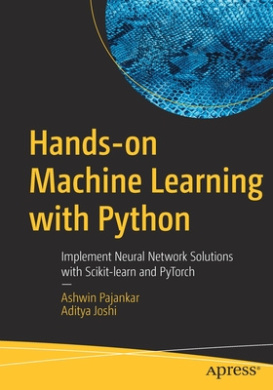
Ashwin Pajankar holds a Master of Technology from IIIT Hyderabad, and has over 25 years of programming experience. He started his journey in programming and electronics with BASIC programming language and is now proficient in Assembly programming, C, C++, Java, Shell Scripting, and Python. Other technical experience includes single board computers such as Raspberry Pi and Banana Pro, and Arduino. He is currently a freelance online instructor teaching programming bootcamps to more than 60,000 students from tech companies and colleges. His Youtube channel has an audience of 10000 subscribers and he has published more than 15 books on programming and electronics with many international publications. Aditya Joshi has worked in data science and machine learning engineering roles since the completion of his MS (By Research) from IIIT Hyderabad. He has conducted tutorials, workshops, invited lectures, and full courses for students and professionals who want to move to the field of data science. His past academic research publications include works on natural language processing, specifically fine grain sentiment analysis and code mixed text. He has been the organizing committee member and program committee member of academic conferences on data science and natural language processing. Chapter 1: Getting Started with Python 3 and Jupyter Notebook Chapter Goal: Introduce the reader to the basics of Python Programming language, philosophy, and installation. We will also learn how to install it on various platforms. This chapter also introduces the readers to Python programming with Jupyter Notebook. In the end, we will also have a brief overview of the constituent libraries of sciPy stack. No of pages – 30 Sub -Topics 1. Introduction to the Python programming language 2. History of Python 3. Python enhancement proposals (PEPs) 4. Philosophy of Python 5. Real life applications of Python 6. Installing Python on various platforms (Windows and Debian Linux Flavors) 7. Python modes (Interactive and Script) 8. Pip (pip installs python) 9. Introduction to the scientific Python ecosystem 10. Overview of Jupyter Notebook 11. Installation of Jupyter Notebook 12. Running code in Jupyter Notebook Chapter 2: Getting Started with NumPy Chapter Goal: Get started with NumPy Ndarrays and the basics of NumPy library. The chapter covers the instructions for installation and basic usage of NumPy. No of pages: 10 Sub – Topics: 1. Introduction to NumPy 2. Install NumPy with pip3 3. Indexing and Slicing of ndarrays 4. Properties of ndarrays 5. Constants in NumPy 6. Datatypes in datatypes Chapter 3 : Introduction to Data Visualization Chapter goal – In this chapter, we will discuss the various ndarray creation routines available in NumPy. We will also get started with Visualizations with Matplotlib. We will learn how to visualize the various numerical ranges with Matplotlib. No of pages: 15 Sub – Topics: 1. Ones and zeros 2. Matrices 3. Introduction to Matplotlib 4. Running Matplotlib programs in Jupyter Notebook and the script mode 5. Numerical ranges and visualizations Chapter 4 : Introduction to Pandas Chapter goal – Get started with Pandas data structures No of pages: 10 Sub – Topics: 1. Install Pandas 2. What is Pandas 3. Introduction to series 4. Introduction to dataframes a) Plain Text File b) CSV c) Handling excel file d) NumPy file format e) NumPy CSV file reading f) Matplotlib Cbook g) Read CSV h) Read Excel i) Read JSON j) Pickle k) Pandas and web l) Read SQL m) Clipboard Chapter 5: Introduction to Machine Learning with Scikit-Learn Chapter goal – Get acquainted with machine learning basics and scikit-Learn library No of pages: 10 1. What is machine learning, offline and online processes 2. Supervised/unsupervised methods 3. Overview of scikit learn library, APIs 4. Dataset loading, generated datasets Chapter 6: Preparing Data for Machine Learning Chapter Goal: Clean, vectorize and transform data No of Pages: 15 1. Type of data variables 2. Vectorization 3. Normalization 4. Processing text and images Chapter 7: Supervised Learning Methods – 1 Chapter Goal: Learn and implement classification and regression algorithms No of Pages: 30 1. Regression and classification, multiclass, multilabel classification 2. K-nearest neighbors 3. Linear regression, understanding parameters 4. Logistic regression 5. Decision trees Chapter 8: Tuning Supervised Learners Chapter Goal: Analyzing and improving the performance of supervised learning models No of Pages: 20 1. Training methodology, evaluation methodology 2. Hyperparameter tuning 3. Regularization in linear regression 4. Regularization in logistic regression 5. Regularization in decision trees 6. Crossvalidation, K-fold cross validation 7. ROC Curve Chapter 9: Supervised Learning Methods – 2 Chapter Goal: Learn more algorithms No of Pages: 15 1. Naive bayes 2. Support vector machines 3. Visualization of decision boundaries Chapter 10: Ensemble Learning Methods Chapter Goal: Learn the in-depth background of ensemble learning methods No of Pages: 10 1. Bagging vs boosting 2. Random forest 3. Adaboost 4. Gradient boosting Chapter 11: Unsupervised Learning Methods Chapter Goal: Detailed theory and practically oriented introduction to dimensionality reduction and clustering algorithms No of Pages: 20 1. Dimensionality reduction 2. Principle components analysis 3. Clustering 4. K-Means method 5. Density-based method Chapter 12: Neural Networks and Pytorch Basics Chapter Goal: Understand the basics of neural networks, deep learning, and Pytorch No of Pages: 10 1. Introduction to Pytorch, tensors 2. Tensor operations 3. Exercises Chapter 13: Feedforward Neural Networks Chapter Goal: In-depth introduction to basic dense neural networks along with necessary mathematical background and implementation. (chapter might split into two while writing) No of Pages: 20 1. Perceptron model 2. Neural network and activation functions 3. Multiclass classification 4. Cost functions and gradient descent 5. Backpropagation 6. Pytorch gradients 7. Linear regression with PyTorch 8. Basic dense network with PyTorch for regression 9. Basic dense network with Pytorch for classification Chapter 14: Convolutional Neural Network Chapter Goal: Explore details behind CNNs and implement two solutions for image classification No of Pages: 20 1. Dense network for digits classification 2. Image filters and kernels 3. Convolutional layers 4. Pooling layers 5. CNN for digits classification 6. CNN for image classification Chapter 15: Recurrent Neural Network Chapter Goal: Understand sequence networks and implement them for forecasting values (or text classification) No of Pages: 15 1. Introduction to recurrent neural networks 2. Vanishing gradient problem 3. LSTM 4. RNN batches, LSTM 5. Text classification Problem (or forecasting problem) Chapter 16: Bringing It All Together Chapter Goal: Discuss, conceptualize, design, and develop end to end No of Pages: 20 1. Project 1 2. Project 2