Description
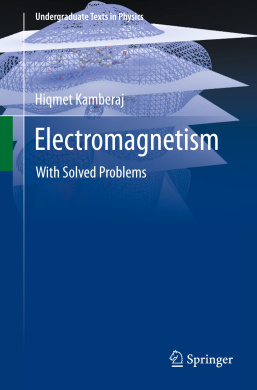
Any curriculum involving science and/or engineering will eventually find itself entering the realm of physics. This book seeks to introduce students to a number of the fundamental concepts in physics and illustrate how different theories were developed out of physical observations and phenomena. The book presents multi-chapter sections on electrostatics, magnetism and electromagnetic waves, with eyes on both the past and the future, touching, along the way, on Coulomb, Gauss, Maxwell, Ohm, Biot-Savart, Ampere, Faraday, Fresnel and Lorentz. The book also contains an appendix that provides the reader with a portion of the mathematical background of vector analysis and vector differential operators. The book approaches its topics through a focus on examples and problem-solving techniques, illustrating vividly how physical theories are applied to problems in engineering and science. The book is primarily aimed at undergraduate students in these two fields, but it also features chapters that are geared towards senior undergraduates working on their final year theses. 1. Electrostatics in Free Space 2. Gauss’s Law 3. Electrostatic Potential 4. Capacitance and Dielectrics 4.5 Electrostatics of Macroscopic Media 5. Electric Current 5.3 Resistance and Ohm’s Law 6. Magnetic Fields 7. Sources of Magnetic Field 8. Magnetism in Matter 8.4 The Magnetic Field of the Earth 8.6 Rowland Ring Apparatus 9. Maxwell Equations of Electromagnetism 9.1 Maxwell’s Equations of EM 9.2 Vector and Scalar Potential of EM Field 9.3 EM Field Energy & Conservation Law 9.4 Conservation Law of Momentum 9.5 Charged Particles in EM Fields 9.6 Macroscopic Maxwell Equations 10. More about Faraday’s Law of Induction 10.1 Moving Conductor in a Closed Circuit 10.1.1 Induced Electric Potential and Electric Field 10.1.2 Generators and Motors 10.2 Inductance 10.2.1 Self-inductance 10.2.2 Mutual Inductance 10.3 Oscillations in an LC Circuit 10.4 The RL Circuit 10.5 The RLC Circuit 10.5.1 Case 1 10.5.2 Case 2 10.5.3 Case 3 10.6 Alternating Current Circuits 10.6.1 AC Sources and Phases 10.6.2 Resistors in an AC Circuit 10.6.3 Inductors in an AC Circuit 10.6.4 Capacitors in an AC Circuit 10.6.5 The RLC Series in an AC Circuit Power in the AC Circuit 10.8 Resonance in the RLC Series Circuit 11. Some Applications of Electromagnetic Theory 11.1 Electrostatic Properties of Macromolecular Solutions 11.1.1 The pH and Equilibrium Constant 11.1.2 Charge on DNA and Proteins 11.1.3 Charge States of Amino Acids 11.1.4 Salt Binding 11.1.5 Energy Cost of Assembling a Collection of Charges 11.1.6 The Poisson-Boltzmann Equation 11.1.7 Calculation of pKa of Amino Acids in Macromolecules 11.2 Wireless Charging 11.2.1 Tightly Coupled Wireless Power Systems 11.2.2 Loosely Coupled Highly Resonant Systems 11.3 Superconductivity 12. Electromagnetic Waves 12.1 Electromagnetic Waves in Vacuum 12.2 Electromagnetic Waves in Medium 12.3 Transmission Lines 12.4 Coherence of Electromagnetic Waves 12.5 Polarization of Electromagnetic Waves 12.6 Reflection of Electromagnetic Waves 13. Molecular Optics 13.1 Dispersion of Electromagnetic Waves in Gases 13.2 Dispersion of Electromagnetic Waves in Solids 13.3 Conduction Models 13.4 Refraction Index of a Conductor 13.5 Wave Propagation in Dilute Plasmas A. Vectorial Analysis A.1 Vector Calculus A.2 Vector Differential Operators A.3 Stokes’ Formula A.4 Gauss’s Formula A.5 Some Useful Formula A.6 Laplasian A.7 Curvilinear Coordinates References