Description
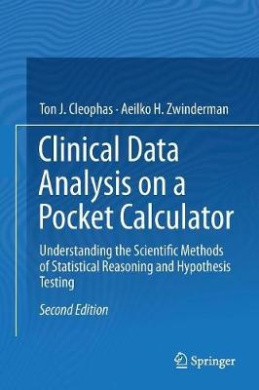
In medical and health care the scientific method is little used, and statistical software programs are experienced as black box programs producing lots of p-values, but little answers to scientific questions. The pocket calculator analyses appears to be, particularly, appreciated, because they enable medical and health professionals and students for the first time to understand the scientific methods of statistical reasoning and hypothesis testing. So much so, that it can start something like a new dimension in their professional world. In addition, a number of statistical methods like power calculations and required sample size calculations can be performed more easily on a pocket calculator, than using a software program. Also, there are some specific advantages of the pocket calculator method. You better understand what you are doing. The pocket calculator works faster, because far less steps have to be taken, averages can be used. The current nonmathematical book is complementary to the nonmathematical “SPSS for Starters and 2nd Levelers” (Springer Heidelberg Germany 2015, from the same authors), and can very well be used as its daily companion. The authors are well-qualified in their field. Professor Zwinderman is past-president of the International Society of Biostatistics (2012-2015), and Professor Cleophas is past-president of the American College of Angiology (2000-2002). From their expertise they should be able to make adequate selections of modern methods for clinical data analysis for the benefit of physicians, students, and investigators. The authors have been working and publishing together for 17 years, and their research can be characterized as a continued effort to demonstrate that clinical data analysis is not mathematics but rather a discipline at the interface of biology and mathematics. The authors as professors and teachers in statistics at universities in The Netherlands and France for the most part of their lives, are convinced that the scientific method of statistical reasoning and hypothesis testing is little used by physicians and other health workers, and they hope that the current production will help them find the appropriate ways for answering their scientific questions. Three textbooks complementary to the current production and written by the same authors are Statistics applied to clinical studies 5th edition, 2012, Machine learning in medicine a complete overview, 2015, SPSS for starters and 2nd levelers, 2015, all of them edited by Springer Heidelberg Germany. Preface I Continuous Outcome Data 1 Data Spread, Standard Deviations 2 Data Summaries: Histograms, Wide and Narrow Gaussian Curves 3 Null-Hypothesis Testing with Graphs 4 Null-Hypothesis Testing with the T-table 5 One-Sample Continuous Data (One-Sample T-Test, One-Sample Wilcoxon 6 Paired Continuous Data (Paired T-Test, Two-Sample Wilcoxon Signed Rank Test) 7 Unpaired Continuous Data (Unpaired T-Test, Mann-Whitney) 8 Linear Regression (Regression Coefficients, Correlation Coefficients, and their Standard Errors) 9 Kendall-Tau Regression for Ordinal Data 10 Paired Continuous Data, Analysis with Help of Correlation Coefficients 11 Power Equations 12 Sample Size Calculations 13 Confidence Intervals 14 Equivalence Testing instead of Null-Hypothesis Testing 15 Noninferiority Testing instead of Null-Hypothesis Testing 16 Superiority Testing instead of Null-Hypothesis Testing 17 Missing Data Imputation 18 Bonferroni Adjustments 19 Unpaired Analysis of Variance (ANOVA) 20 Paired Analysis of Variance (ANOVA) 21 Variability Analysis for One or Two Samples 22 Variability Analysis for Three or More Samples 23 Confounding 24 Propensity Score and Propensity Score Matching for Multiple Confounders 25 Interaction 26 Accuracy and Reliability Assessments 27 Robust Tests for Imperfect Data 28 Non-linear Modeling on a Pocket Calculator 29 Fuzzy Modeling for Imprecise and Incomplete Data 30 Bhattacharya Modeling for Unmasking Hidden Gaussian Curves 31 Item Response Modeling instead of Classical Linear Analysis of Questionnaires 32 Meta-Analysis 1 33 Goodness of Fit Tests for Identifying Nonnormal Data 34 Non-Parametric Tests for Three or More Samples (Friedman and Kruskal-Wallis) II Binary Outcome Data 35 Data Spread: Standard Deviation, One Sample Z- Test, One Sample Binomial Test 36 Z-Tests 37 Phi Tests for Nominal Data 38 Chi-Square Tests 39 Fisher Exact Tests Convenient for Small Samples 40 Confounding 41 Interaction 42 Chi-square Tests for Large Cross-Tabs 43 Logarithmic Transformations, a Great Help to Statistical Analyses 44 Odds Ratios, a Short-Cut for Analyzing Cross-Tabs 45 Logodds, the Basis of Logistic Regression 46 Log Likelihood Ratio Tests for the Best Precision 47 Hierarchical Loglinear Models for Higher Order Cross-Tabs 48 McNemar Tests for Paired Cross-Tabs 49 McNemar Odds Ratios 50 Power Equations 51 Sample Size Calculations 52 Accuracy Assessments 53 Reliability Assessments 54 Unmasking Fudged Data 55 Markov Modeling for Predictions outside the Range of Observations 56 Binary Partitioning with CART (Classification and Regression Tree) Methods 57 Meta-Analysis 58 Physicians’ Daily Life and the Scientific Method 59 Incident Analysis and the Scientific Method 60 Cochran Tests for Large Paired Cross-Tabs Index