Description
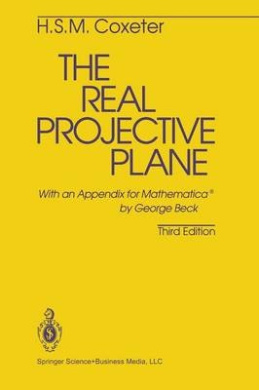
Along with many small improvements, this revised edition contains van Yzeren’s new proof of Pascal’s theorem (1.7) and, in Chapter 2, an improved treatment of order and sense. The Sylvester-Gallai theorem, instead of being introduced as a curiosity, is now used as an essential step in the theory of harmonic separation (3.34). This makes the logi cal development self-contained: the footnotes involving the References (pp. 214-216) are for comparison with earlier treatments, and to give credit where it is due, not to fill gaps in the argument. H.S.M.C. November 1992 v Preface to the Second Edition Why should one study the real plane? To this question, put by those who advocate the complex plane, or geometry over a general field, I would reply that the real plane is an easy first step. Most of the prop erties are closely analogous, and the real field has the advantage of intuitive accessibility. Moreover, real geometry is exactly what is needed for the projective approach to non-Euclidean geometry. Instead of introducing the affine and Euclidean metrics as in Chapters 8 and 9, we could just as well take the locus of ‘points at infinity’ to be a conic, or replace the absolute involution by an absolute polarity. 1. A Comparison of Various Kinds of Geometry.- 11 Introduction.- 12 Parallel projection.- 13 Central projection.- 14 The line at infinity.- 15 Desargues’s two-triangle theorem.- 16 The directed angle, or cross.- 17 Hexagramma mysticum.- 18 An outline of subsequent work.- 2. Incidence.- 21 Primitive concepts.- 22 The axioms of incidence.- 23 The principle of duality.- 24 Quadrangle and quadrilateral.- 25 Harmonic conjugacy.- 26 Ranges and pencils.- 27 Perspectivity.- 28 The invariance and symmetry of the harmonic relation.- 3. Order and Continuity.- 31 The axioms of order.- 32 Segment and interval.- 33 Sense.- 34 Ordered correspondence.- 35 Continuity.- 36 Invariant points.- 37 Order in a pencil.- 38 The four regions determined by a triangle.- 4. One-Dimensional Projectivities.- 41 Projectivity.- 42 The fundamental theorem of projective geometry.- 43 Pappus’s theorem.- 44 Classification of projectivities.- 45 Periodic projectivities.- 46 Involution.- 47 Quadrangular set of six points.- 48 Projective pencils.- 5. Two-Dimensional Projectivities.- 51 Collineation.- 52 Perspective collineation.- 53 Involutory collineation.- 54 Correlation.- 55 Polarity.- 56 Polar and self-polar triangles.- 57 The self-polarity of the Desargues configuration.- 58 Pencil and range of polarities.- 59 Degenerate polarities.- 6. Conics.- 61 Historial remarks.- 62 Elliptic and hyperbolic polarities.- 63 How a hyperbolic polarity determines a conic.- 64 Conjugate points and conjugate lines.- 65 Two possible definitions for a conic.- 66 Construction for the conic through five given points.- 67 Two triangles inscribed in a conic.- 68 Pencils of conics.- 7. Projectivities on a Conic.- 71 Generalized perspectivity.- 72 Pascal and Brianchon.- 73 Construction for a projectivity on a conic.- 74 Construction for the invariant points of a given hyperbolic projectivity.- 75 Involution on a conic.- 76 A generalization of Steiner’s construction.- 77 Trilinear polarity.- 8. Affine Geometry.- 81 Parallelism.- 82 Intermediacy.- 83 Congruence.- 84 Distance.- 85 Translation and dilatation.- 86 Area.- 87 Classification of conics.- 88 Conjugate diameters.- 89 Asymptotes.- 810 Affine transformations and the Erlangen programme.- 9. Euclidean Geometry.- 91 Perpendicularity.- 92 Circles.- 93 Axes of a conic.- 94 Congruent segments.- 95 Congruent angles.- 96 Congruent transformations.- 97 Foci.- 98 Directrices.- 10. Continuity.- 101 An improved axiom of continuity.- 102 Proving Archimedes’ axiom.- 103 Proving the line to be perfect.- 104 The fundamental theorem of projective geometry.- 105 Proving Dedekind’s axiom.- 106 Enriques’s theorem.- 11. The Introduction of Coordinates.- 111 Addition of points.- 112 Multiplication of points.- 113 Rational points.- 114 Projectivities.- 115 The one-dimensional continuum.- 116 Homogeneous coordinates.- 117 Proof that a line has a linear equation.- 118 Line coordinates.- 12. The Use of Coordinates.- 121 Consistency and categoricalness.- 122 Analytic geometry.- 123 Verifying the axioms of incidence.- 124 Verifying the axioms of order and continuity.- 125 The general collineation.- 126 The general polarity.- 127 Conics.- 128 The affine plane: affine and areal coordinates.- 129 The Euclidean plane: Cartesian and trilinear coordinates.- Appendix 1. The Complex Projective Plane.- Appendix 2. How to Use Mathematica by George Beck.