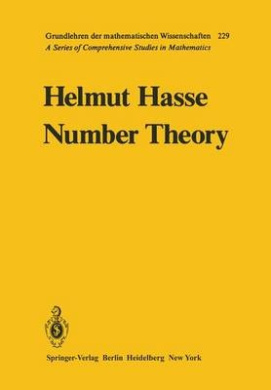
Description
From the reviews: “…a fine book […] When it appeared in 1949 it was a pioneer. Now there are plenty of competing accounts. But Hasse has something extra to offer.[…] Hasse proved that miracles do happen in his five beautiful papers on quadratic forms of 1923-1924. […]It is trite but true: Every number-theorist should have this book on his or her shelf.” –Irving Kaplansky in Bulletin of the American Mathematical Society, 1981 Biography of Helmut Hasse (1898-1979) Born on August 25, 1898 in Kassel, Germany, Helmut Hasse studied at the University of Gttingen after WWI. Of his teachers there including Landau, Hilbert and Ehmy Noether, Hecke influenced him most. In 1820, Hasse went to Marburg, and under the direction of Kurt Hensel, discovered what is now known as the Hasse principle, or “local-global” principle, in algebraic number theory. He held further positions at the universities in Kiel and Hall prior to 1933. With the troubles of 1933, Hermann Weyl, who had succeeded Hilbert in the foremost chair or mathematics in Germany, resigned and Helmut Hasse was appointed in this place. The following year, Hasse became director of the Mathematical Institute at Gttingen. From 1939 to 1945, Hasse worked in Berlin for the navy on problems in ballistics. He returned to Gttingen but was soon dismissed by the British occupation forces. In 1946 he took a research position at the Berlin Academy. Thereafter, he held positions at the Humboldt University in East Berlin, and, from 1950 until retirement in 1966, at the University of Hamburg. At Halle, Hasse obtained fundamental results on the structure of central simple algebras over local fields. In Marburg, he did joint work with Brauer and Emmy Noether on simple algebras, also on elliptic curves and topological fields. In particular, he proved the analogon of the Riemann Hypothesis for zeta functions of elliptic curves. Both of Hasses famous books ber die Klassenzahl abelscher Zahlkrper und Zahlentheorie appeared during his years in Berlin.